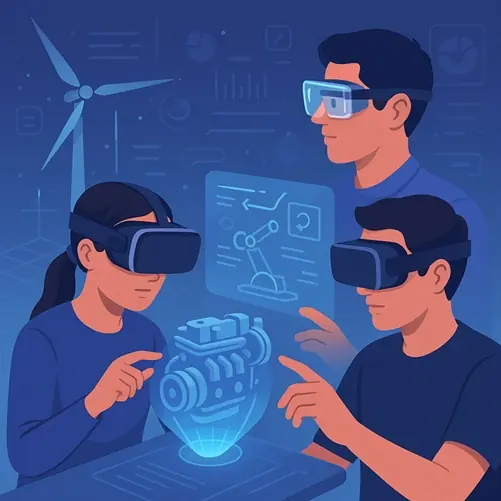
Immersive technologies are revolutionising VET. This course introduces teachers to virtual reality (VR), augmented reality (AR), and simulation tools that enhance practical skill training in safe and engaging ways.
Description
Hands-on practice is essential in vocational education, and VR/AR offers new methods to simulate real-life scenarios without risks. Participants will experiment with immersive platforms, create digital simulations, and learn how to integrate these technologies into their teaching practice. Case studies will demonstrate how industries already use VR and AR for training and upskilling.
Aims and objectives
- Introduce VR, AR, and simulation technologies for VET
- Provide practical training on immersive tools and platforms
- Explore pedagogical benefits of using simulations for technical skills
- Support digitalisation in line with Erasmus+ priorities
Learning outcomes:
- Apply VR/AR tools to create engaging vocational lessons
- Design simple simulations for technical practice and assessment
- Understand safety and inclusivity aspects of immersive learning
- Integrate digital simulations into institutional teaching strategies
Target groups:
- Teachers working in public or vocational schools who want to include sustainability and ecological ideas in their lessons..
Minimum level of language: English, B1/B2
Location: Málta (Malta)
Duration of training: 30 lessons, 6 days
Dates:
- 30 March-04 April 2026 Planned
- 29 March-03 April 2027 Planned
The final confirmation of the course is subject to reaching the minimum number of participants.
Price: EUR 480 + EUR 50 REGISTRATION FEE
This price includes the course, certificate, Erasmus+ documentation (if needed).
Price is NET price. VAT: 0% for organisations with a valid EU VAT number;
in all other cases VAT may apply – please contact us for details.
Applicable funds: As part of the Erasmus+ Key Action 1 (KA1), all costs for mobility /travel expenses, course fees, accommodation, subsistence fee/ are covered by the fund.
Planned program
Day 1: Monday: Introduction to Immersive Technologies in Vocational Education
- Course introduction, participant presentations, expectations
- Overview of immersive technologies: VR, AR, MR, and simulations
- Benefits and limitations of immersive learning in VET
- Current trends and industry applications
- Pedagogical foundations of immersive learning
Day 2: Tuesday: Exploring VR and AR Tools and Platforms
- Introduction to VR headsets and AR devices
- Overview of VR/AR platforms (e.g. CoSpaces Edu, ClassVR, Spatial, Merge Cube)
- Exploring existing educational simulations
- Hardware and software requirements
- Hands-on use of VR and AR devices
- Testing immersive learning environments
- Evaluating educational applications
Day 3: Wednesday: Designing Learning Activities Using VR and AR
- Instructional design principles for immersive learning
- Aligning simulations with learning outcomes
- Creating engaging and meaningful immersive lessons
- Integrating immersive tools into lesson plans
- Designing a VR/AR-based learning activity
- Developing lesson scenarios using immersive tools
Day 4: Thursday: Creating Simple VR/AR and Simulation Content
- Introduction to simulation creation tools (e.g. CoSpaces Edu, ThingLink, Unity basic concepts)
- Creating simple VR/AR learning environments
- Adding interactivity and instructional elements
- Using simulations for skills training
- Creating a simple VR or AR simulation
- Developing interactive learning scenarios
Day 5: Friday: Pedagogical Integration, Safety, and Inclusion
- Pedagogical benefits and challenges
- Supporting different learning styles
- Accessibility and inclusion considerations
- Safety and ethical considerations
- Assessing learning using simulations
- Designing inclusive immersive learning activities
- Developing assessment strategies using simulations
Day 6: Saturday: Developing an Institutional Implementation Plan and Course Closure
- Designing an immersive learning implementation strategy
- Planning integration into institutional curriculum
- Presentation of participant projects
- Peer feedback and discussion
- How will I use what I have learned in my lessons?
- What did I learn this week? Preparation for dissemination – 5-minute presentation by each participant
- Course evaluation and feedback
- Certificates and certificates of attendance
- Issuing of certificates – photo session